



Leisure (Veronica)
Search the Site



Newsletter Signup
Sign up to our newsletter to receive updates about what's going on at the NFCT
Leisure (Veronica)
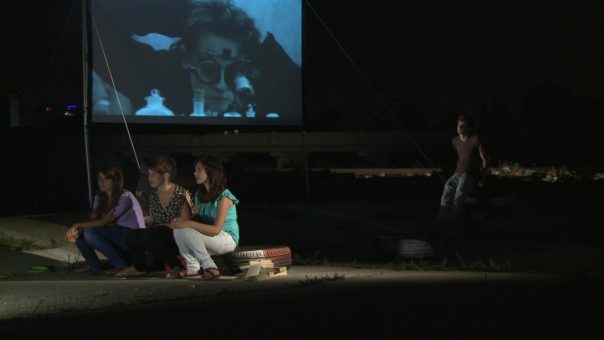
Leisure (Veronica) opens with a long shot lingering on Seurat’s famous work identified with pointillism: “A Sunday Afternoon on the Island of a Grande Jatte” (1884). The camera focuses on the neck of a girl whose torso shows the tattooed name “Veronica”, calling to mind the name of the saint Veronica, who mopped the sweat of Jesus on his way to crucifixion, after which the image of his face was stamped upon her kerchief. This anecdote also gave her the mythological status of patron of photography.The viewer is invited to watch a nighttime environment on an unidentified beach, where we can see youngsters watching horror films that include extremely violent scenes with surreal elements by breakthrough directors such as Werner Herzog, David Kronenberg, and Tim Burton. The work proposes we think about the relationship between cinema and its material and non-material accumulation in consciousness. Cinema creates a simultaneous and divided space that is multi-linear and chaotic, but nonetheless it often presents itself as an optical unity that denies the ongoing and flickering existence of its various parts within consciousness. This work proposes that we think about the way in which pioneering images may create new space, even while maintaining their initial form in various aspects.
Director: Alona Friedberg
Producer: Curator: Maayan Amir
Supporter(s): The New Fund for Cinema and Television
Film Name in Hebrew: שעות הפנאי (ורוניקה)
Leisure (Veronica) opens with a long shot lingering on Seurat’s famous work identified with pointillism: “A Sunday Afternoon on the Island of a Grande Jatte” (1884). The camera focuses on the neck of a girl whose torso shows the tattooed name “Veronica”, calling to mind the name of the saint Veronica, who mopped the sweat of Jesus on his way to crucifixion, after which the image of his face was stamped upon her kerchief. This anecdote also gave her the mythological status of patron of photography.The viewer is invited to watch a nighttime environment on an unidentified beach, where we can see youngsters watching horror films that include extremely violent scenes with surreal elements by breakthrough directors such as Werner Herzog, David Kronenberg, and Tim Burton. The work proposes we think about the relationship between cinema and its material and non-material accumulation in consciousness. Cinema creates a simultaneous and divided space that is multi-linear and chaotic, but nonetheless it often presents itself as an optical unity that denies the ongoing and flickering existence of its various parts within consciousness. This work proposes that we think about the way in which pioneering images may create new space, even while maintaining their initial form in various aspects.
Director: Alona Friedberg
Producer: Curator: Maayan Amir
Supporter(s): The New Fund for Cinema and Television
Film Name in Hebrew: שעות הפנאי (ורוניקה)



Newsletter Signup
Sign up to our newsletter to receive updates about events and submission deadlines
Greenhouse Website

Our Facebook




 With the support of the Ministry of Culture - The Israel Film Council