



Lod – Between Hope and Despair
Search the Site



Newsletter Signup
Sign up to our newsletter to receive updates about what's going on at the NFCT
Archives
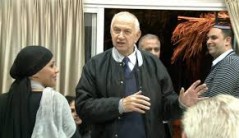
At the very center of Israel is the city of Lod, a city teeming with violence and fear. Lod, where Jews, Christians and Moslems live together (75,000 inhabitants), is a depiction of governmental and municipal despair. Can a newly appointed, 79-year old mayor save Lod and give its people hope?
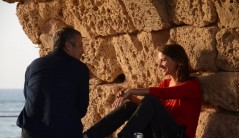
Based on a short story by Efrat Stieglitz
A man and a woman in a car, on their way to a hotel. This will be the first night they have entirely to themselves. She’s filled with anticipation, fantasizing. He’s just happy to be there. Thin cracks are slowly revealed in this portrait of intimacy. Moments of love, passion and disappointment are collected to form a close look at a couple.
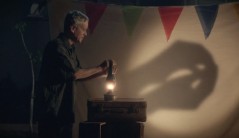
Based on Amir Gutfreund’s short story
A story of a friendship taking place in Israel in the mid 1980s between Uncle Nathan, a Holocaust survivor who communicates only through his shadow puppets, and his day-dreaming nephew. As Nathan’s shadow puppets act become less childish and more eccentric, his last connection to the world and rescue from family alienation lies in the hands of his youngest family member. The film is a mixed work of both live-action and animation.

Based on Avri Harling’s short story
It’s been several days now that Yoav, a freelance real-estate agent, is having trouble sleeping because of obscure crying sounds. His wife, on the other hand, seems to be sleeping a lot more and very deeply so, completely undisturbed by the cries. Even though they share the same space, the two seldom meet. As the days go by and all his attempts to locate or make the cry stop fail, Yoav feels as though he is starting to lose control.

Precocious eleven-year-old Yoav and his family must leave their familiar neighborhood in Tel Aviv for new opportunties in the northern city of Nazrat Elit. Malka, his mother, finds a job in a hotel and with it, new confidence and assertiveness. His older sister Anat falls in love with a romantic would-be rock star whose own sister, Mor, survives an encounter with a talent-hunter with impure intentions. Yoav befriends Nir, a strange and sensitive boy his age, and together with their new friends they undertake an eventful journey to Moon Hill, the best place in the country from which to see the moon. It is also the place where the different stories converge and gain meaning.
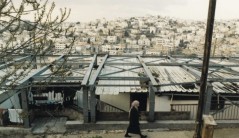
Seven families live in Tel Rumeidah, or “Jesse’s Land,” in a controversial settlement in Hebron. They have been struggling for fourteen years to hold on to this small hill in the center of the town which they believe they hold the right to, and in doing so have stirred much political debate in Israeli society. This film allows a rare and intimate look into the world of this extreme group of Jewish settlers.

Tomer wears two hats as both the manager of a trendy Tel Aviv coffee house and as the youth director for a group of teenagers in the small town of Azur. The film explores Tomer’s personal odyssey over a period of two years as he helps the jaded youth group members navigate moments of estrangement and violence, and eventually helps them stage an original play at the local theatre. The creative process is one of both hurt and healing, as the confusion and chaotic inner world of the kids is revealed through questions of their social and sexual identities. As they open up, so must Tomer.
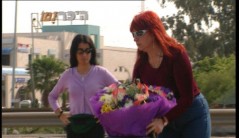
After losing their former business, Gila and Motti resort to selling flowers and strawberries on the roadside to make a living. Motti is a 51-year-old man of honor with a checkered past and Gila is 39-year-old fiery red head divorcee with two kids. She is neurotic, sarcastic, a workaholic and toothless. The couple hopes to make enough money over the Passover holiday to have Gila’s teeth fixed. They must overcome daily clashes with the police, municipal authorities, and the local mob in order to survive. When things become hectic over the Passover weekend, the people who stop to make a last minute flower purchases for the holiday might hold the key to their salvation.

This film explores Israel’s obsession with consumption and consumerism in the 1990s by following Doron Tsabari, a washed up television actor who rose to fame on the show “Harishon Babidur” (The First in Entertainment). During this time, Tsabari realized his dream of becoming not just a film star but the most popular man in Israel. This is a penetrating, funny ,and sad film about a TV star with no limits, whose love for himself depends entirely upon the audience’s love for him, man who has succeeded in capturing the spirit of his own time, and has crowned himself a post-modern king.

Beyond Hitler’s Grasp tells the story of Bulgaria, one of the smallest European nations, and how the country managed to save and protect its Jewish population while under German rule during World War II. A hopeful and inspring story amidst the horrors of the Holocaust, Bulgaria protected its Jewish minority from the death camps despite its pro-Nazi government, the Nuremberg laws, and constant direct pressure from Hitler himself.
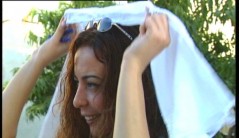
Sima and Orly have recently turned their backs on secular life and joined the ultra orthodox “Shas” party. Svetlana is a recent Jewish immigrant from Uzbekistan desperately trying to adopt an Israeli identity and establish an independent life for herself and her two daughters. Jihad is a Palestinian Muslim, born to a family of refugees, searching for a national identity while conflicted by the fact that she is also an Israeli citizen. Having completed law school, she alternates between wanting a career and a strict tradition that does not allow her the freedom she seeks. These four women live in a religious, national, and cultural labyrinth that does not allow them to meet. Their stories are told against the backdrop of Ramleh, Israel, between the general elections of 1999 and 2001.

China is one of the first countries in the world to label overuse of the Internet a clinical condition. To combat what authorities deem the greatest social crisis for youth today, the Chinese government has created treatment facilities to detox and cure teenagers of their addictions to online life.
But what starts out as an already-fascinating look at ways that technology may be destroying the lives of Chinese youth quickly becomes something more. As the unorthodox psychological sessions continue and the teenage boys begin to share with their parents the reasons why they feel more connected to disassociated voices in cyberspace than to their families, Web Junkie chronicles the results of a nation going through one of most drastic transformations in human history. In honest and wrenching ways that transcend national borders, this film is a thoughtful examination of a society in flux and a technology-addled generation on the precipice of an unknown future.
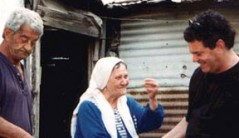
On the eastern skirts of Haifa sits Wadi Rushmia, a region of abandoned quarries from the days of the British Mandate. Throughout the generations this place has been home to a variety of immigrant populations, first to Jewish immigrants from North Africa and Eastern Europe and later from Ethiopia and Russia. Eventually, displaced Palestinian Arabs came to live in the place known as “the dump” as well. Told in three instalments each filmed ten years apart, the film chronicles the changes that occurred in Wadi Rushmia, a microcosm of Israeli society, as well as the changes undergone by the city of Haifa overall.
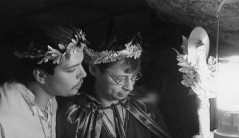
27-year-old Svetlana is a married woman, a mother, and a registered nurse. 17-year-old Vadim works as a garbage man. Though seemingly very different, the two have a unique passion in common: They participate in a live-action, interactive role playing game set in a forest. Players dress up in medieval costumes and infuse magic into an enchanted world of wizards, warlocks, princesses, and knights. Through conniving schemes, devious acts, and alliances, they fight to prevent the loss of the kingdom. Interwoven into the complex plot of the games is also the real life story behind the birth of Vadim’s daughter.
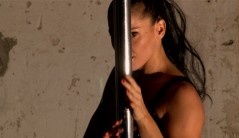
Pole dancing may have started in strip clubs, but over the past few years it has won international recognition as an art form, a sport and a means of empowering women. Director Isri Halpern follows Neta Lee Levy, the founder of Israel’s first pole dancing studio, as she competes for the European title. He discovers an outspoken and frank woman, who challenges the very world she lives in no less than she challenges the world she came from. She demonstrates that, at the dawn of the twenty-first century, a woman in a bikini and high heels may also be made of the same material champions are made of.
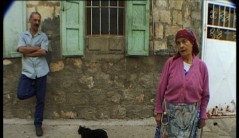
As Margalit and Ilan, the only two Jews in a remote Arab village, fight over the right to own the key to an ancient synagogue, a third Jew decides to build a rival synagogue. This film is a tragic-comic allegory on the human urge to fight and unite at any cost.
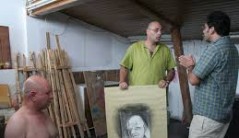
The following story of Aviv Talmor, a frustrated poet and literature teacher from Tel Aviv, is true…mostly.
Aviv is informed that his father whom he had never known, has died, bequeathing him one Israeli lira (less than one penny). Aviv embarks upon a legal battle over his inheritance as part of his brave and painful search for a much desired father figure. He unexpectedly discovers evidence that his grandfather was the illegitimate son of the first Israeli painter Ira Yan and Israeli national poet Haim Nahman Bialik, his spiritual father. As he begins to publish these news, Israel’s literary community is shocked by his claims which threaten to impact the national poet’s reputation.
In a series of obsessive and dangerous efforts to prove his bloodline to Bialik, Aviv loses all grasp of reality.
Did Bialik really have a son? Is Aviv really Bialik’s great grandson?
Will this discovery change our perception of Bialik forever?

Aviv Geffen, the grandson of legendary Moshe Dayan and number one Israeli rockist, is rapidly becoming a mythic figure himself. He was the last person to embrace Rabin before he was assassinated. The charismatic, bisexual singer-songwriter has rapidly become the Jim Morrison or Bob Dylan of his country, a voice that represents peace and integrity for a troubled young generation. Concert footage reveals the depth of feeling that many Israelis have for Aviv: hip, youthful women and men are clearly enamored of his presence.
Directed by Tomer Heymann, this feature documentary follows the life of Aviv Geffen, a controversial Israeli singer whose liberal upbringing led him to refuse to serve in the Israeli military. Geffen has become a spokesperson for the country’s youth, and this film chronicles the rise of his career, his family roots, and how he finds the inspiration to write music.
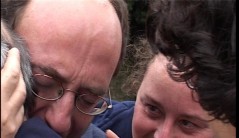
An immigrant from Argentina, Jorge Weller has built a life for himself in Ra’anana, Israel but constantly yearns for the family he left behind in South America — His aging father, his older sister Graciela, and his younger sister Clarisa, a zestful, mentally challenged woman of 30. Clarisa’s genuine wisdom shines through her clinically defined mental disability. With an emotional IQ that is far above “normal,” Clarisa’s penetrating insights shed light on Jorge’s struggle and conflicted feelings between his new life and his past.
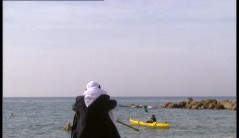
A group of Palestinian tourists on a three-day sightseeing trip to Israel. The tourists come from the Occupied Territories. The windows of the bus open up onto an unknown portrait of Israel. And looking from the outside in, we get an unusual glimpse into the very heart of Palestinian society. Filmed in 2000, just months before the outbreak of the second Intifada, this is simple human tale of a weekend jaunt across the border that becomes an unfinished journey traversing time and criss-crossing between the emotional recollections of a vanished past and the harsh realities of the present day. This is the homeland, but they are visiting it as tourists. This is the state that has occupied them for decades, but it is also a country, just like any other, with people not very different from them.

A group of citizens set out to change the municipal plan to demolish and reconstruct Rabin Square. This film seamlessly connects venue with emotion, exploring the personal stories, national dramas, and every day life of a space which can see, absorb, and experience, but can only tell its story through the people who visit it.
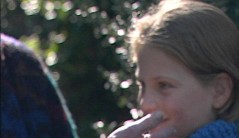
The lives, habits, and philosophies of women from different backgrounds and stages of life are presented in a series of interviews which explore their hardships, fears, hopes, disappointments ,and yearnings. From these varying stories, a complex mosaic of views on matrimony, family, motherhood, old age, faith, and death is created, resulting in a new take on life and purpose.
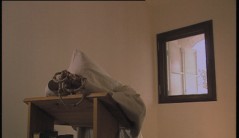
Through the striking cinematography of Nurit Aviv and a soundtrack composed of beautiful chanting and haunting silence, this film explores the mystery and discretion of forty silent nuns living at the Beit Jamal monastery near Jerusalem. The film attempts to deal with the cinematic challenge posed by their very silence and incorporates texts from the diaries of silent nuns from the Middle Ages through the present.

Newsletter Signup
Sign up to our newsletter to receive updates about events and submission deadlines
Greenhouse Website

Our Facebook




 With the support of the Ministry of Culture - The Israel Film Council